
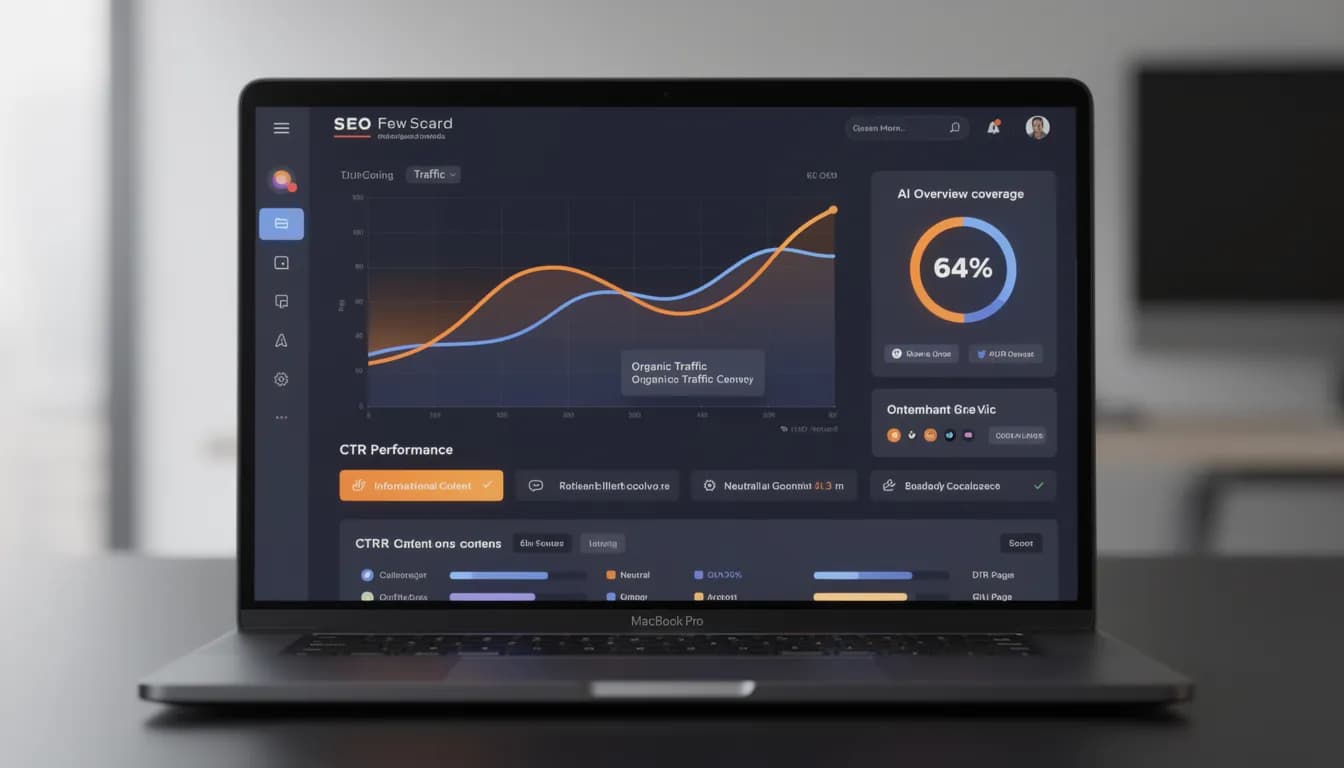
Everyone's asking the wrong question. The question isn't whether to stop informational content — it's whether the informational content you're publishing is actually doing anything for your business. The teams I talk to are running content operations that generate traffic and deliver almost no pipeline. You already know which articles I mean: the ones ranking on page one, pulling 3,000 sessions a month, and converting nobody. And the uncomfortable part? Every piece of advice out there tells you to publish more. Is your informational content building topical authority and feeding your commercial pages — or is it just keeping your editorial calendar full?
Your best-performing informational article might be quietly working against your pipeline right now — and your analytics won't show you why. AI Overviews now answer the majority of informational queries before a user ever clicks a result. The traffic model that made "publish educational content" the safest bet in SEO has structurally changed. Content that ranked, attracted readers, and eventually converted them to leads now often ranks, attracts nobody, and sits. The question most guides won't answer is: which of your informational content still has a future, which should be pivoted, and which is genuinely worth stopping. That's the framework you'll find here.
Why Informational Content SEO Is Under Real Pressure Right Now
The pressure on informational content isn't a temporary algorithm wobble. It's a structural shift.
Google's AI Overviews now appear for a significant share of informational queries — estimates from SEO studies in 2025 put direct answer features at over 60% of informational SERPs. That means a well-optimized "what is" or "how to" article can hold a top-3 position and still see a fraction of the clicks it earned two years ago. Zero-click is the dominant outcome for definitional and procedural content.
This isn't an argument to abandon informational content. It's an argument to be precise about which informational content still earns its keep.
The informational content that's under the most pressure:
- Generic definitions: "What is content marketing?" — Google answers this inline. Your article competes with the AI response box, not just other results.
- How-to content for tasks users complete once: "How to set up Google Analytics" — answered in the Overview, never bookmarked, never revisited.
- Trend-chasing "X is happening" posts without a proprietary angle — no differentiation, no reason for a reader to stay.
The informational content that still works:
- Deep comparisons and nuanced takes that AI Overviews can't confidently synthesize
- Content that supports topical authority for your commercial pages (more on this below)
- Educational content where your product is the natural next step — and you build that bridge explicitly
The pressure is real. The response isn't to stop. It's to stop publishing the wrong kind.
Does Informational Content Still Rank?
Yes. Definitively. The question is whether rank is the right metric.
In 2026, a #2 ranking for an informational keyword with 5,000 monthly searches can generate 400 clicks or 1,400 clicks — depending on whether an AI Overview, a featured snippet, or People Also Ask boxes occupy the zero-position above you. Rank alone tells you almost nothing about the traffic or conversion return you're actually getting. This is the core argument behind the shift from traditional SEO to answer engine optimization — see our SEO vs AEO comparison for a full breakdown of what's changing and why rank metrics are losing their predictive value.
What to measure instead:
- Clicks per impression — a ranking that generates less than 2% CTR on a non-branded informational keyword is likely below-the-fold on an AI-heavy SERP. That article is a vanity metric.
- Topical authority contribution — does this article internally link to, and drive crawl equity toward, your commercial pages? If it ranks in isolation without feeding anything, it's a dead end.
- Assisted conversions — is this content appearing in multi-touch paths that end in trial signups, demo requests, or purchases? GA4's path exploration makes this visible.
Rank is a prerequisite. It's not a result. An informational article that ranks and converts 0 readers to anything is occupying publishing resources and internal link budget that could be doing real work.

Informational vs Transactional Content: The Imbalance That Kills Pipeline
The problem isn't content quality. It's content mix.
Here's the imbalance I see consistently: teams publish 10 informational articles for every 1 transactional or commercial page. The logic sounds defensible — you build trust before you sell. In practice, this ratio produces an audience that reads your content and goes elsewhere to buy.
The correct ratio depends on your product and funnel, but as a working benchmark:
- Top of funnel (informational): 40–50% of content output
- Middle of funnel (comparison, alternatives, "best X for Y"): 30–35%
- Bottom of funnel (transactional, feature pages, pricing, versus): 20–25%
Most teams I've looked at are running 70–80% informational and wondering why organic traffic doesn't convert.
The other failure mode: informational content with no internal path to commercial pages. You write "how to improve your SEO rankings" — a strong informational topic — but nowhere in that article do you link to your keyword research feature, your SERP analysis tool, or a case study showing the outcome. The reader gets what they came for and leaves. You've invested 8 hours of writing to hand a potential customer to Google.
The fix isn't to stop informational content. It's to treat every informational article as a bridge, not a destination. Every piece needs at least one explicit internal link to a commercial page, a feature page, or a conversion-path asset (email signup, free trial, product demo).

The 4 Signals That Tell You to Stop, Pivot, or Double Down
This is the framework most content audits skip. Instead of a blanket "stop informational content" or "keep going," use these four signals to make the call article by article.
Signal 1: Traffic + Zero Conversion Path
Pattern: Article ranks, pulls traffic, has no internal links to commercial content, no CTA, no email capture. Decision: Pivot. Add a CTA block, insert 2–3 internal links to commercial pages, and test for 60 days. If conversion doesn't move — stop refreshing it, let it age.
Signal 2: Low Click-Through Despite Good Ranking
Pattern: Article sits at #3–5 but CTR is below 1.5%. AI Overview or SERP features are eating the clicks above you. Decision: Pivot or stop. Either reposition the article toward a longer-tail angle where SERP features are less dominant, or retire the keyword and redirect editorial effort.
Signal 3: Strong Rankings + Topical Authority Signal
Pattern: Article ranks well, links to commercial pages, and those commercial pages have better crawl depth and domain authority as a result. Decision: Double down. This is informational content working exactly as intended. Build cluster depth around it.
Signal 4: Traffic From Keywords With Purchase Intent Misalignment
Pattern: Article attracts traffic from keywords 3+ funnel stages above your product. For example, an enterprise B2B SaaS attracting 90% of traffic from "what is marketing" — an audience that won't convert for years, if ever. Decision: Stop. Redirect that editorial energy toward middle-funnel content where your audience actually makes decisions.
When to Double Down on Informational Content (The Cases Where It Wins)
There are specific scenarios where increasing informational content output is the correct strategic move. These are them.
You're building a new cluster from scratch. Commercial pages without topical authority backing them rank poorly. If you're entering a new topic area — say, AI SEO or local marketing automation — publishing 6–8 informational articles around the topic before building out commercial pages is the correct sequence. You earn the topical authority that makes your commercial content rankable.
Your product is the natural answer to the question. If someone searches "how to find low competition keywords" and your product is literally a keyword research tool, a well-built informational article on that topic creates a direct conversion path. The article answers the question; your product solves the problem permanently. That's a short funnel.
You're targeting content that AI Overviews can't confidently synthesize. Nuanced comparison articles, multi-tool reviews, data-backed original research, detailed how-to content with tool-specific context — these resist AI Overview replacement because they require proprietary judgment. These are high-value informational assets. This is also where the AI-native marketing approach becomes relevant: content designed to be cited by AI systems, not just indexed by Google, follows different rules than traditional SEO content.
You're supporting a strong backlink and PR strategy. Original research, industry surveys, and data-driven informational content attract backlinks at a rate that generic commercial pages don't. If link acquisition is a current priority, informational content with a data angle is still the highest-leverage play.
How to Build an Informational Content Strategy That Actually Converts
The problem isn't informational content. The problem is informational content published without a conversion architecture. Here's how to build one.
Step 1: Audit what you have. Before publishing anything new, categorize your existing informational content by: (a) does it rank? (b) does it have internal links to commercial pages? (c) does it appear in any conversion path? Articles that rank but fail on (b) and (c) are your first priority for pivots. This is the audit most teams never run — and it surfaces fast wins in hours, not months.
Step 2: Map every informational article to a commercial endpoint. For each informational article, identify the one commercial page it should be pushing toward: a feature landing page, a versus page, a pricing page, a free trial. If you can't identify the endpoint, the article doesn't have a place in your strategy.
Step 3: Build the bridge explicitly. Don't assume readers will find the commercial page. Add a CTA block after the conclusion. Insert 2–3 contextual internal links within the body. For high-traffic articles, consider a soft-sell paragraph that transitions from the educational content to the product context naturally.
Step 4: Monitor CTR, not just rank. Set up a simple GSC filter that shows click-through rate by article. Anything ranking in positions 1–5 with CTR below 2% is either dominated by SERP features or poorly optimized for the title/meta description. Both are fixable.
Step 5: Adjust your mix quarterly. Look at your published content split. If you're above 60% informational by volume, shift the next quarter's output toward comparison and transactional content until the mix stabilizes. You don't need to stop informational publishing — you need to balance it.
Tools like Allable can run this audit automatically — surfacing which informational articles are contributing to topical authority and commercial page performance, and which are sitting in isolation. The goal isn't to stop. It's to know, with data, which content is working and which is filling space. If you're evaluating what belongs in your stack, the best AI SEO tools comparison covers how these platforms differ in the kind of content intelligence they surface.
Frequently Asked Questions
- Is Informational Content Worth It in 2026?
- Yes — but only if it's connected to a commercial outcome. Informational content that ranks, earns topical authority, and drives internal traffic to commercial pages delivers compounding ROI. Informational content that ranks in isolation — no conversion path, no internal linking — is an expensive vanity metric. The worth depends entirely on the architecture around it, not the content itself.
- When Should You Actually Stop Creating Content?
- Stop creating a specific type of content when: (1) it consistently ranks but generates zero pipeline impact after 90 days with optimization, (2) the SERP is dominated by AI Overviews with no featured-snippet opportunity, or (3) the keyword attracts an audience that is fundamentally misaligned with your buyer profile. "Stop creating content" as a blanket answer is almost never the right call — "stop creating this specific type for this audience" usually is.
- What's the Right Informational Content Strategy Going Forward?
- The right strategy has three components: (1) a clear map from every informational article to a commercial endpoint, (2) a content mix that balances top-of-funnel education with middle and bottom-of-funnel decision content, and (3) a quarterly CTR and conversion audit that retires or pivots articles that rank without contributing to pipeline. Volume without architecture produces traffic. Architecture converts it.
Know Which Informational Content Is Working — and Which Isn't
Allable audits your content mix automatically — surfacing which informational articles contribute to topical authority and commercial performance, and which are filling space. Free to start.
Stop Guessing — Start Knowing Which Content Actually Works
Allable tracks your content performance across Google and AI search in one dashboard. See which pieces are driving results and which are wasting budget — before your next editorial meeting.