Best ChatGPT SEO Tools in 2026: Tested for Marketing Teams (Not Developers)
 Written by Martin J.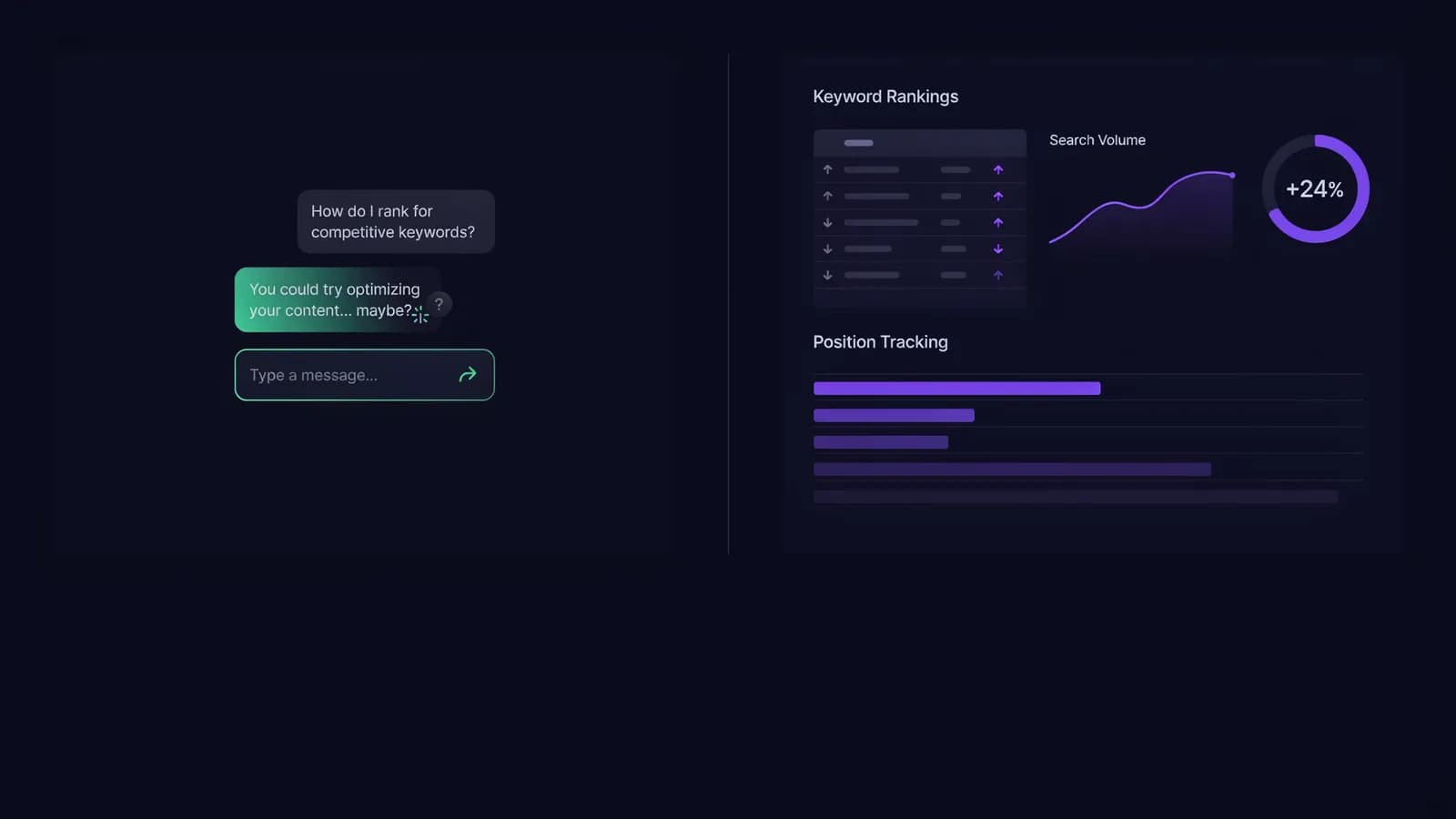
You've been asking ChatGPT SEO questions for months. It gives you reasonable keyword ideas, explains concepts clearly, and it's free. But somewhere between your third 'analyze this competitor page' request and the moment it told you search volume data with complete confidence — and was wrong — you started wondering: is this actually an SEO tool, or am I just using a very convincing search engine replacement? That depends entirely on what you need it to do.
Two Things Searchers Mean by "ChatGPT SEO Tools"
When someone searches "ChatGPT SEO tools" in 2026, they might mean two completely different things. The first is what most people assume: tools that use ChatGPT (or similar AI) to help you do SEO tasks — write meta descriptions, generate keyword clusters, draft content briefs. That's the use case that dominated 2023 and 2024.
The second meaning has emerged more recently. Searchers are now looking for tools that help them appear inside ChatGPT answers — get cited when someone asks ChatGPT about their industry, show up in Perplexity responses, rank in AI Overviews. This is a fundamentally different problem. It's not about prompting an AI. It's about being visible to an AI when it's answering your potential customers. This article covers both — the four tools that use ChatGPT for SEO work, and the three tools built specifically to get you cited in AI-generated answers.
Quick Comparison: ChatGPT SEO Tools at a Glance
Tool | Primary Use Case | Price | ChatGPT Integration |
|---|---|---|---|
Allable | Full SEO + content + AI visibility | $49/mo | Native — ChatGPT workflows built-in |
ChatGPT Plus | Hands-on SEO prompting | $20/mo | Is ChatGPT — no SEO data layer |
Surfer SEO | Content optimization + AI assist | $99/mo | AI Assist (GPT-based) built into editor |
Jasper | AI writing with SEO mode | $49/mo | GPT-4 powered, SEO templates |
Profound | AI answer tracking + brand mentions | Contact | Monitors ChatGPT/Perplexity/Gemini |
Otterly.AI | AI visibility monitoring | Tiered | Tracks brand in AI results |
Allable AI Visibility | AI citation monitoring (built-in) | Included in $49/mo | Native AI visibility dashboard |
Tools That Use ChatGPT for SEO
1. Allable — Best Native ChatGPT SEO Platform ($49/mo)
Allable is built around a chat-first interface where every SEO task — keyword research, content briefs, meta optimization, campaign planning — runs through an AI layer that connects to real data sources. You're not prompting a blank model. When you ask Allable for keyword volumes, it queries live search data. When you ask it to audit a page, it pulls actual SERP results. This is the gap ChatGPT alone cannot close.
At $49/mo, Allable covers SEO, content, competitor analysis, social, and campaigns in one subscription. For marketing teams spending $150–$300/mo across three separate tools, that math matters. The onboarding takes about 20 minutes. You connect your domain, set your market, and the platform already knows your competitive context before you ask your first question. The workflow integration is tighter than Surfer or Jasper because it's not bolted onto an existing product — it was designed with ChatGPT-style workflows from the start.
Pros:
- Real search data behind every AI response — no invented volumes
- Covers SEO, content, campaigns, and AI visibility in one platform
- Chat-first interface requires no technical setup
- $49/mo includes features that cost $300+ spread across Semrush + Jasper + Surfer
Cons:
- Less name recognition than Semrush or Ahrefs among enterprise buyers
- Content editor is less mature than Surfer's dedicated editor
- Smaller backlink database than Ahrefs
2. ChatGPT Plus — Best for Hands-On SEO Prompting ($20/mo)
ChatGPT Plus at $20/mo is genuinely useful for certain SEO tasks. Writing meta descriptions for 50 URLs at once — it does that well. Drafting a content outline when you already know your keyword — fast and useful. Rewriting thin product descriptions, generating FAQ content, brainstorming semantic variations of a seed keyword — all reasonable use cases where a blank model with strong language ability is enough.
What ChatGPT cannot do: give you real search volume data, tell you who ranks for a keyword and why, analyze your site's technical SEO issues, or track your positions. The confident-sounding numbers problem is real and persistent. GPT-4o does not have access to live Google Keyword Planner or Ahrefs data. When it generates figures, they are statistically plausible estimates at best and fabrications at worst. If you use ChatGPT Plus for SEO, treat it as a writing assistant with SEO knowledge — not as an SEO tool.
Pros:
- $20/mo — lowest price point on this list
- Genuinely fast for writing tasks: meta, FAQs, outlines
- GPT-4o handles nuanced content instructions well
- No learning curve; most marketers already use it
Cons:
- No real keyword data — volumes are fabricated
- No rank tracking, no SERP analysis, no technical audit
- Outputs need fact-checking before use in any brief
- Not an SEO tool — it's a writing assistant you can use for SEO tasks
3. Surfer SEO with AI Assist ($99/mo)
Surfer SEO's core product is its content editor: you target a keyword, Surfer analyzes the top-ranking pages, and tells you which terms to include, how long your article should be, and how to structure it. The AI Assist layer, added over the last two years, uses GPT-based generation to draft sections directly inside that editor — so your AI output is already shaped around what ranks.
The $99/mo entry price is for the Essential plan, which covers 30 articles/month. That's meaningful for a small team producing consistent content. The main limitation: Surfer is focused narrowly on on-page content optimization. It won't help with keyword research from scratch, technical SEO, or off-page strategy. It's a specialist tool. If content production is your primary SEO lever and you want AI writing baked into a data-driven editor, Surfer is the clearest choice at its price point.
Pros:
- Content editor backed by actual SERP data — not guessing at structure
- AI Assist drafts inside the editor, so output is already optimized
- Keyword clustering and content planning built-in
- Established tool with a proven track record
Cons:
- $99/mo is expensive if you're not publishing at least 10 articles/month
- Narrow focus — only content; no campaigns, no technical SEO, no AI visibility
- AI Assist quality varies; you'll still rewrite significant portions
- No built-in AI citation or brand monitoring
4. Jasper — Best AI Writing with SEO Mode ($49/mo)
Jasper started as a pure AI writing tool and has progressively added SEO-specific templates and a "SEO Mode" that integrates with Surfer SEO if you have both subscriptions. At $49/mo (Creator plan), you get unlimited content generation, 50+ templates including SEO-focused ones, and the ability to fine-tune the AI on your brand voice.
The SEO Mode is the differentiator for marketing teams. It connects Jasper's writing capability to Surfer's content scoring, which means your AI-generated draft gets real-time guidance on keyword usage. Without the Surfer integration, Jasper is a powerful writing tool that lacks any real SEO data layer — similar to ChatGPT Plus but with better templates and brand voice training. If you already use Surfer, Jasper as a writing layer makes sense. As a standalone SEO tool, it's limited.
Pros:
- Brand voice training produces more consistent output than vanilla ChatGPT
- 50+ SEO templates cover most common content types
- Surfer integration makes AI content data-driven (if you have Surfer)
- $49/mo is competitive for what you get
Cons:
- Surfer integration costs extra ($99/mo on top of Jasper $49)
- No keyword research or rank tracking built-in
- Without Surfer, you're paying $49/mo for a writing tool
- Brand voice training requires setup time and sample content
Tools That Get You CITED in ChatGPT
There's a second meaning to "ChatGPT SEO tools" that most 2024-era articles missed entirely. These tools don't help you use ChatGPT — they help you appear inside ChatGPT answers when your potential customers are asking questions. As AI search adoption grows, being cited in a ChatGPT response or Perplexity result is becoming as valuable as ranking on page one. The tools below were built specifically to track, measure, and improve that visibility.
5. Profound — Best for AI Answer Tracking
Profound monitors how your brand appears across ChatGPT, Perplexity, Gemini, and other AI answer engines. You set up your brand, your competitors, and the questions your customers are likely asking. Profound then runs those queries at regular intervals and tells you: who gets cited, how often, in what context, and what sources the AI models are pulling from to justify those citations.
This is genuinely new SEO territory. The data Profound surfaces — which domains AI models trust for which topics, how often your brand appears vs. your competitors, what content triggers a citation — has no equivalent in traditional rank tracking. Pricing is enterprise-focused (contact sales for a quote). That positions it as a tool for agencies and mid-to-large marketing teams, not a first-time buyer. For teams seriously investing in AI search visibility, Profound is the most comprehensive option available.
Pros:
- Tracks brand mentions across ChatGPT, Perplexity, Gemini simultaneously
- Identifies which competitor content is getting cited — and why
- Reveals which of your own content drives AI citations
- Reporting depth is unmatched in the AI visibility category
Cons:
- No public pricing — requires sales conversation
- Likely expensive for small teams
- Category is new — best practices still evolving
- Does not replace traditional SEO rank tracking
6. Otterly.AI — Best for AI Visibility Monitoring
Otterly.AI takes a more accessible angle on AI visibility. You track specific prompts — the questions your buyers ask in AI tools — and Otterly monitors which brands appear in the answers over time. It covers ChatGPT, Perplexity, Gemini, and Claude. The interface is cleaner than enterprise tools and the setup is lighter: you're not configuring a full brand intelligence suite, you're tracking prompt-level visibility.
The tiered pricing makes it accessible to smaller teams that want to start measuring AI visibility without a sales call. The trade-off is depth: Otterly tracks prompt-level answers well but doesn't go as deep on citation source analysis or competitive intelligence as Profound. For a marketing team just starting to measure their AI search presence, Otterly is the logical entry point. For a team that already has budget for a serious AI visibility program, Profound's depth justifies the premium.
Pros:
- Lower barrier to entry than enterprise competitors
- Covers ChatGPT, Perplexity, Gemini, Claude in one dashboard
- Prompt-level tracking helps you see exactly where you're missing
- Useful for competitive benchmarking — see who beats you in which answers
Cons:
- Less citation-source depth than Profound
- Tiered pricing can rise quickly as you add more prompts to track
- Reporting is less mature than enterprise alternatives
- No integration with traditional SEO rank tracking
7. Allable AI Visibility — Built-In Feature (Included in $49/mo)
Allable's AI visibility monitoring is built into the base subscription — no additional purchase required. Inside the platform, you can track how your brand and key topics appear in AI-generated answers across major models. It covers the core use case: are you being cited, who is being cited instead of you, and what content is driving those citations.
For teams already using Allable for SEO and content work, this removes the need to subscribe to a separate AI visibility tool. The feature set is less deep than Profound's dedicated product — this is a built-in dashboard, not a standalone AI search intelligence platform. But for most marketing teams, the coverage is sufficient to answer the question: "Are we showing up in ChatGPT answers for our category?" Allable's position is unique on this list: it's the only tool that helps you both use AI for SEO tasks and track your visibility in AI answers.
When to Use ChatGPT Directly vs. a Dedicated Tool
ChatGPT alone makes sense for a narrow set of tasks. If you need to rewrite 20 product descriptions, draft a meta description for a page you already understand, or generate FAQ content around a topic you know well — ChatGPT Plus at $20/mo is fast and sufficient. The ceiling appears the moment you need data. If your question involves search volume, ranking position, competitor gaps, technical issues, or AI citation tracking, you've exceeded what a language model alone can answer honestly.
Dedicated tools pay for themselves when two conditions are true: you're making decisions based on the output, and those decisions have measurable stakes. A keyword research brief built on invented ChatGPT data costs you time and potentially months of ranking effort. A content plan built on Surfer's SERP analysis costs $99/mo but is grounded in what actually ranks. The break-even calculation is simple: one prevented bad decision usually covers several months of subscription fees.
FAQ — ChatGPT SEO Tools
Can ChatGPT actually do SEO?
Partially. ChatGPT handles language-layer SEO tasks well: writing meta descriptions, structuring content outlines, rewriting thin copy, brainstorming topic clusters. It cannot provide real keyword data, check technical SEO issues, track rankings, or analyze actual SERP competitors. Treat it as a writing assistant with SEO knowledge — not a replacement for tools connected to live search data.
What is the best free ChatGPT SEO tool?
ChatGPT's free tier (GPT-4o mini access) lets you do basic SEO writing tasks at no cost. For anything data-driven — keyword volumes, competitor analysis, rank tracking — you'll need a paid tool. There is no free tool that combines reliable SEO data with AI generation.
How do I get cited in ChatGPT answers?
AI citation is driven by authority signals similar to traditional SEO: high-quality content on specific topics, strong domain authority, structured data, and being referenced by other trusted sources. Tools like Profound and Otterly.AI help you track which content is driving citations and where gaps exist. There's no shortcut — the same fundamentals that make you rank on Google make AI models trust your content.
Is Allable better than using ChatGPT directly for SEO?
For SEO work specifically, yes. The core difference is data. Allable connects AI workflows to real search data — live keyword volumes, SERP analysis, competitor coverage — while ChatGPT generates plausible-sounding but often fabricated numbers. At $49/mo, Allable also includes AI visibility monitoring, which ChatGPT doesn't offer at all. ChatGPT Plus at $20/mo makes sense as a writing assistant alongside a data-driven tool, not as a replacement for one.
What is the difference between AI SEO tools and ChatGPT SEO tools?
"AI SEO tools" is the broader category — any SEO tool using machine learning or AI, which now includes almost everything. "ChatGPT SEO tools" has two distinct meanings in 2026: tools that use ChatGPT (or similar LLMs) to help you execute SEO tasks, and tools that help you appear inside ChatGPT answers when users search there. The second meaning is newer and growing faster — as AI search adoption increases, visibility in AI-generated answers is becoming a distinct marketing objective alongside traditional rankings.
--- Allable is the only platform that both uses AI for SEO tasks AND tracks your brand visibility in ChatGPT answers — starting at $49/month. Try Allable free →